

I was trying to run my business while doing the receptionist's job and my own, and caring for my parents at the same time. Here's the missed-call text-back system I built for myself on Twilio, what it actually costs a month, and what the Canadian done-for-you versions charge.
This one’s my own business rather than a client’s, so I can show you the whole thing, including the parts I got wrong.
For about nine years I’ve been running a business, doing the receptionist’s job for it, and living at home as a caregiver for my elderly parents. Three roles, one person, one phone. Manning that phone all day was never going to happen.
What the big guys bought
The enterprise answer is a person. A live answering service or a call centre picks up whatever the business can’t, around the clock, and bigger firms often push that offshore to keep it affordable.
The companies that buy it are the ones where a single missed call is worth several hundred dollars or more. Law firms, medical practices, emergency trades, anyone whose caller has a problem that won’t wait until Monday. Once one lost call is worth enough, the arithmetic stops being hard.
I’m not going to print a monthly figure for that tier, because it isn’t public. Answering services quote per call or per minute, and almost always through a sales conversation first.
Strip it back and they’re paying for two things: every caller gets a response, and the business ends up with a record of who rang. A person on a headset does both. So does a text message sent within seconds of the missed call, and that version runs a few dollars a month.
What I built instead
A one-person business in Ontario. No staff, no reception desk, no after-hours cover, and a phone that had to be answered by the same person doing the billable work.
In my own words at the time:
It is extremely difficult to be the receptionist as well as the person helping clients, and it got worse when I became a caregiver for my parents, because that became the priority rather than being on call whenever the phone rang.
I can’t put a dollar cost on those missed calls and I’m not going to invent one. A customer whose site is down and a call from my parents aren’t really the sort of thing that has a number attached.
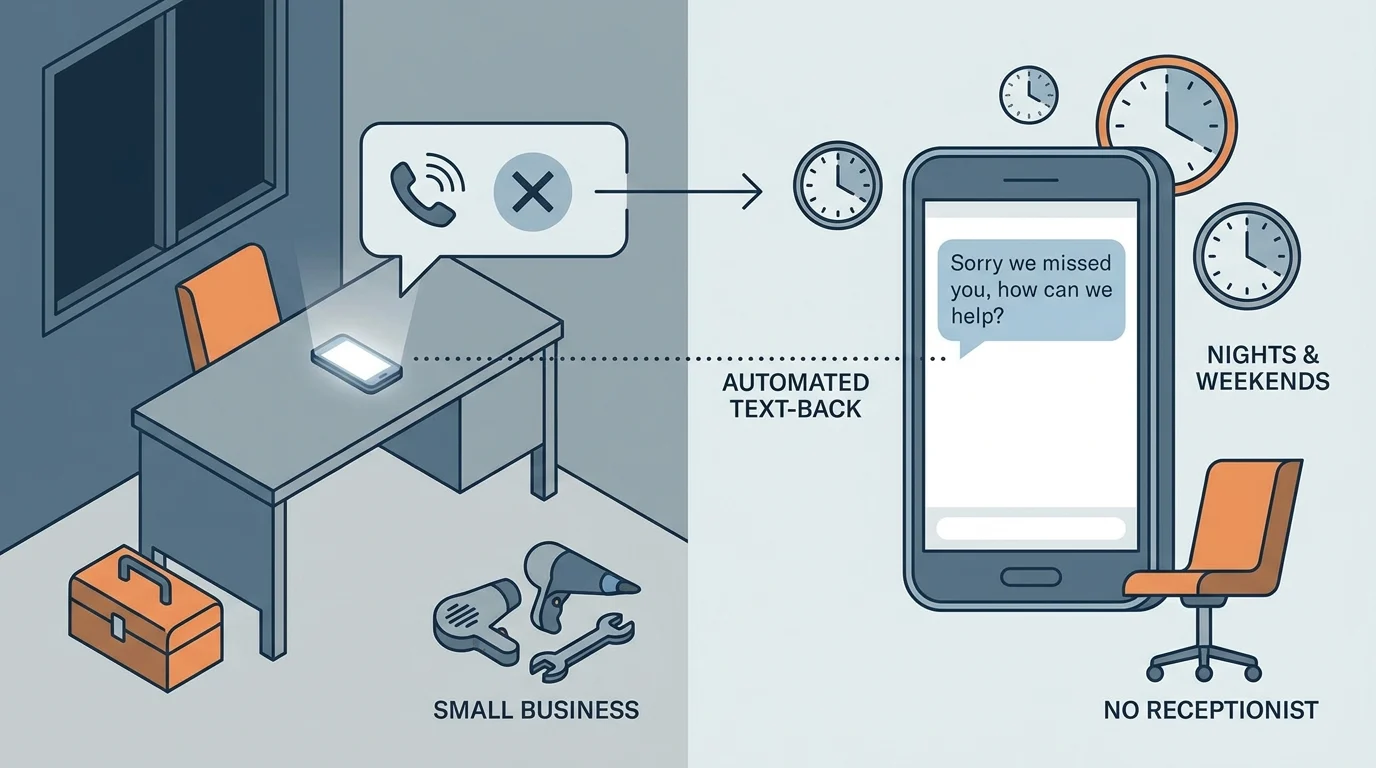
What I built was a Twilio number and a Studio flow. My mobile forwarded to it whenever I was busy. The flow picked up, let the caller leave a message, then did the two things that matter: it texted me to say who’d rung, and it texted them back to say I’d return the call.
That second text is the whole product. The caller stops wondering whether they’ve reached a working business, and they stop dialling the next name on the list.
The first text does a different job. When I’m away from the house, an alert naming who rang is the difference between knowing my parents have called and finding out hours later.
What it cost, three ways
Every price below came off the company’s own page on 1 September 2026. Twilio bills in US dollars, which I can tell you with confidence because I pay the bill, though their Canadian rate pages never actually say so. Canadian figures use a planning rate of US$1 to C$1.50, deliberately above the official rate so it soaks up the card spread. Tax is extra.
Build it yourself: about US$3 a month. Twilio charges $1.15 a month for a local number, $0.0085 a minute to receive a call, $0.0083 per text segment, and $0.0025 every time a Studio flow runs. Canadian carriers then bolt their own fee onto every message, between $0.0064 and $0.0084 depending on whether your caller is with Bell, Rogers, Telus, Freedom or Videotron.
Work one missed call through. A minute and a half of inbound voice is about a cent and a half. The Studio run is a quarter of a cent. The text to the caller is around $0.016 once the carrier fee lands, and the text to me is another $0.016. Call it five cents a missed call.
At 40 missed calls a month, roughly my own volume, that’s $2 of usage plus the $1.15 number. All-in, year one: about US$38, or roughly C$57 before tax. What it also cost me was three hours the first time. I’d expect under an hour now.
Buy it done: $49 to $79 a month. Two Canadian services sell this finished.
AutoTextBack.ca advertises $249 to set up and $49 a month after that, covering a dedicated local number, the forwarding, the message, a dashboard and spam filtering. Cancel any time, with a $30 fee if you later port the number away. Nowhere on their site does it say what currency any of that is in, so I opened the checkout, which settles it: CA$249.99, with US dollars offered as a conversion beside it. Canadian, and a dollar more than the page advertises. All-in, year one: about C$838.
Sowa Answers runs $79, $149 or $299 a month for AI reception and call capture, which covers 24/7 answering as well as the missed-call text. They’re the only company I found in this category that puts the letters CAD next to their prices. Everyone else leaves you guessing. All-in, year one on Essential: $948 CAD.
Done for you: $60 to $300 to set up. That one’s mine. Full disclosure: the done-for-you option here is my own service, and I’ve priced it beside the others so you can see where it stops being worth paying me. The range moves on how many numbers are involved, whether you’re porting an existing line or taking a new one, and how much work the message needs. There’s no monthly to me. You pay Twilio directly, the same few dollars I pay. All-in, year one, at the top of my range: about C$357 plus tax.
If you can follow the steps below, do that and keep the money. What you’re buying from me is the hour where the flow fires twice, or doesn’t fire at all, and you can’t see why.
What changed
All of this is self-reported, and there’s no before-and-after call count, because I wasn’t logging a thing before I built it. I’d rather say that than hand you a tidy figure I reconstructed afterwards.
What I get now is simple enough. I know who rang. I can decide who to ring back first. Every call gets logged and something happens automatically whether or not I’m holding the phone.
That matters most when I’m out of the house. A customer whose site is down gets an answer within seconds of ringing, and if my parents call while I’m away, the alert reaches me and I know to ring back. Both of those were the point.
What I would do differently
I’d cost it out before starting. Twilio bills in a dozen small line items, and unless you already know your call volume and your average call length you can’t work out the monthly in advance. I couldn’t, and I’d been running it a while before the shape of the bill was obvious.
I’d expect the reporting to be the weak point. With the Twilio build everything lands on my phone or in my email and that’s it. There’s no view across calls and customers unless you build one yourself.
That’s why I moved to HighLevel, which has missed-call text-back built in and an app called Lead Connector that gives you that visibility on your phone and on the web. Full disclosure again: HighLevel setup is something I offer as a service, so I’ve got an interest in you liking it.
From their own page on 1 September 2026 it’s US$97, US$297 or US$497 a month, and I know that’s US dollars because I pay it rather than because the page says so. Numbers and messages get billed on top, so US$97 is a floor, and those are agency plans: a single owner buys the US$97 one. Be honest with yourself about what that buys. At US$97 against US$3 you’re buying a CRM that happens to include missed-call text-back, and it took me a few days to learn rather than three hours. If the missed call is the actual problem, the Twilio build or either Canadian service handles it for a fraction of that.
Do it yourself this week
About three hours the first time, and most of that is the flow.
- Open a Twilio account and buy a local number. It’s $1.15 a month and you can hand it back if this doesn’t work out.
- Set conditional call forwarding on your mobile so a call you don’t answer lands on the Twilio number. Your carrier publishes the dial codes on their support site.
- Build a Studio flow with four steps: answer, play a short greeting, record a message, send two texts.
- Write the text to the caller. Name your business, say you’ll ring back, ask one question, and give people a way to tell you to stop.
- Write the text to yourself, and put the caller’s number in it. That’s the thing you’ll want at a red light.
- Ring your own line from another phone, let it go unanswered, and time the text. Then do it again from a phone on a different carrier.
Step six is where you find out whether your forwarding fires when you genuinely miss a call, or only when you actively decline one. That distinction matters more than anything else here, because the canned reply already sitting in your phone is the decline-only kind. It can’t help you when you’re under a sink, on a ladder, or driving between jobs, which are exactly the moments this is for.
Key takeaways
- The enterprise version of this is a human answering service, bought by firms where one lost call is worth hundreds. Built yourself on Twilio, the same job runs about five cents a missed call plus $1.15 for the number, call it US$3 a month, and it arrives as a dozen small line items. Work out your volume first.
- I charge $60 to $300 to install it and take nothing monthly. The steps above are the same steps, so if you can follow them you don’t need me.
- Sowa Answers is the only company here that prints its currency. Twilio and HighLevel are US dollars, which I know from paying them. AutoTextBack turned out to be Canadian, and I could only establish that by opening its checkout. Do the same before you budget.
- I moved to HighLevel for the reporting and I offer HighLevel setup as a service, so weigh that when I recommend it. At US$97 plus usage against US$3, that’s a CRM purchase rather than a missed-call fix.
- Nothing here was measured, so what you’ve got is my own account and a system that does what I needed.
Keep reading

Your Phone Rings at 7 p.m. Here's Who Should Answer (and What It Costs)
An Ontario non-profit had every call landing on one person's phone, including the evening ones asking whether a registration had gone through. Here's the $10-a-month Canadian system I put in instead, what the enterprise version costs, and what I charge to install it.
Aug 26, 20267 min read
One tactic a week
Get the next one on Tuesday.
What the big guys do, the small-business version, what it costs, and how to have it running by Friday.